The Continuous Nature of Digitalization
Digitalization is guiding organizations toward new ways of creating value and staying relevant in today’s digital world and Innovation is the differentiator between those who adapt and those who fall behind.
Digitalization as a natural and strategic shift
Digitalization represents both a natural and at times, strategic shift in how organizations adopt and drive their operations. It streamlines processes, enables data-driven decision-making, strengthens collaboration and information sharing, enhances service delivery, and ultimately improves overall performance.Rather than being an emerging technology, digitalization is a continuation of organizational evolution. It supports core activities—daily operations, performance management and strategic planning—that organizations have always carried out, now executed more efficiently and effectively.
The Evolution of Digitalization
Digitalization is often perceived as a recent strategic priority, yet its foundations date back to the 1950s, when mainframe computers—large, reliable and powerful systems designed to process vast amounts of data securely—were adopted by governments, large corporations and research institutions. These systems enabled the large-scale processing and early automation of administrative and analytical tasks, establishing the first strong link between technology and organizational efficiency.
By the 1970s, organizations—particularly in the public sector and academia—leveraged Automatic Data Processing to standardize and optimize routine administrative activities, which reinforcing technology’s role as an operational efficiency enabler.
In the 1980s, as data volumes and organizational complexity increased, the focus shifted toward Information Systems, emphasizing the strategic use of information to support management control and decision-making. Moreover, during the late 1980s, the Internet emerged as a historic inflection point. And, companies such as Cisco Systems fueled the rapid expansion of networking technologies, connecting organizations, businesses and people worldwide in ways never seen before—fundamentally transforming how we work, live and organize society.
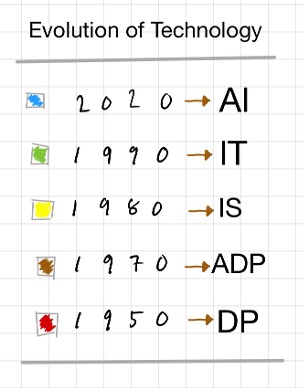 In the 1990s, growing reliance on these interconnected information systems made it clear that technology required dedicated governance, resilient infrastructure and specialized expertise. This led to the formalization of Information Technology (IT) functions and the establishment of centralized IT organizations responsible for scalability, reliability, user support and the protection of information assets amid rising global security and cyber threats.
In the 2000s, the rise of the web, enterprise software and early cloud computing shifted technology from a support function to a strategic business enabler. Organizations began integrating digital systems into core operations, emphasizing efficiency, standardization and global scale while expanding investments in data centers, enterprise platforms and outsourcing models.
During the 2010s, cloud computing, mobile technologies, social platforms and big data accelerated digital transformation across industries. Digital platforms became integral to customer experiences and business models, requiring CIOs and CTOs to shift from managing systems of record to enabling faster, more agile product development and continuous delivery at scale in order to support organizational development.
Entering the 2020s, advances in Artificial Intelligence (AI) and analytics tools—combined with the normalization of remote and hybrid work—once again redefined the technology mandate. Strategically, this evolution shifts technology from a support function to a core driver of organizational capability—enabling learning systems, predictive intelligence and increasingly autonomous decision-making that power growth, competitive advantage and long-term resilience.
Standards power digitalization
The foundation of today’s digitalization is closely linked to the innovation and evolution of data networking standards and system architectures. As with many successful industries, for example the telephony industry, railways etc standards are essential for enabling interoperability, scalability and innovation—and the IT industry is no exception.
For example, the Open Systems Interconnection (OSI) model, introduced in 1984, provided a structured – and to a significant extent standardized framework for organizing and understanding network communication. Alongside, OSI a new networking protocols were under development that enable more robust network services.
By the early 1990s, TCP/IP had emerged as the dominant network protocol suite, forming the technical backbone of the Internet and enabling large-scale connectivity across organizations and industries.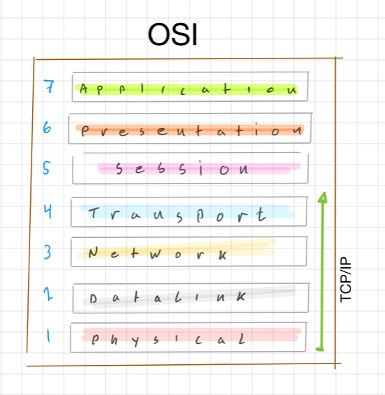
Together, the OSI model and the TCP/IP protocol stack continue to play a critical role in modern digital environments. As TCP/IP enables reliable and scalable operational connectivity, while the OSI model provides a common analytical and conceptual structure for designing, governing and troubleshooting complex systems.
This complementary relationship remains particularly valuable for analyzing and architecting contemporary digital solutions, including cloud infrastructures, security architectures and DevOps models for planing, design, building, operate and supporting software development for digital infrastructure in organizations.
Digitalization as the Outcome of Long-Term Technological Evolution
Placed in a broader historical context, this technical evolution reflects a continuous trajectory that began in the 1950s with the introduction of mainframe computing. Since then, the IT industry has advanced through the development of interoperable technologies and standards, enabling organizations to streamline operations and improve performance.
Despite this progress, one of the key challenges remains the selection of appropriate IT solutions—those that integrate seamlessly, support effective information sharing, and enable business operations with minimal disruption. Ultimately, digitalization is not a transient trend, but the natural outcome of sustained technological standardization and ongoing organizational adaptation